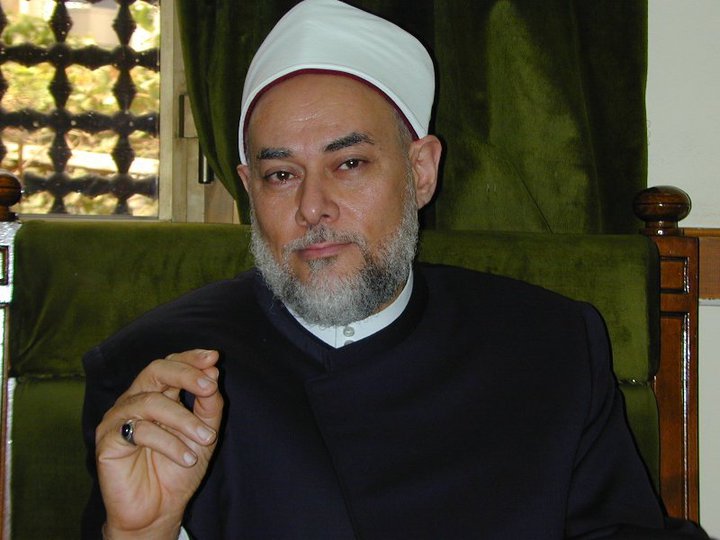
Sheikh Ali Gomaa was born on March 3rd 1952 in Bani Suwaif, Upper Egypt. He was raised in a pious household that respected knowledge. His father, a lawyer specializing in personal status shariah law, transferred his love of books to his son whose private library now boasts over 30,000 titles and is sought out by students and researchers from around the world in need of rare texts.
Sheikh Ali began memorizing the Quran at the age of ten and, although he did not go to religious schools, by the time he graduated from high school he had studied the six canonical collections of hadith as well as Maliki jurisprudence. When it came time for him to go to college he had the choice to enter either the faculty engineering or the faculty of commerce. He chose commerce since it was a field that would allow him the spare time to continue his religious studies while he was in school.
After graduating from college Sheikh Ali enrolled in al-Azhar University. During his first year in al-Azhar he memorized many of the foundational texts that other students who had gone through the al-Alzhar high school system had already encountered. These included works in jurisprudence, Arabic grammar, Quranic recitation, and hadith methodology. After completing a second bachelor's degree from al-Azhar in 1979, Sheikh Ali enrolled in a master's degree program at the same university's department of shariah and law. He obtained his master's degree in 1985 followed by a PhD from the same department in 1988.
In addition to his official studies, Sheikh Ali spent time with many sheikhs and masters of the shariah sciences and the spiritual path outside of the university setting. The most influential of these sheikhs was the Moroccan hadith scholar and Sufi Sheikh Abdullah bin Siddiq al-Ghumari who considered Sheikh Ali to be one of his most accomplished students.
Other scholars that Sheikh Ali studied with include: Sheikh Abd al-Fattah Abu Ghuda, Sheikh Muhammad Abu Nur Zuhayr, Sheikh Jad al-Rabb Ramadan Goma', Sheikh al-Husayni Yusif al-Shaykh, Sheikh Muhammad Yasin al-Fadani, Sheikh Abd al-Jalil al-Qarnishawi al-Maliki, Sheikh al-Azhar Sheikh Jad al-Haqq Ali Jadd al-Haq, Sheikh Abd al-'Aziz al-Zayat, Sheikh Ahmed Muhammad Mursi al-Naqshibandi, Sheikh Muhammad Zaki Ibrahim, and Sheikh Muhammad Hafidh al-Tijani.
Before his appointment as Grand Mufti of Egypt, Sheikh Ali was Professor of Juristic Methodologies at al-Azhar University. In addition to teaching classes on the university campus, in the mid-1990's Sheikh Ali reestablished the tradition of giving lessons in the al-Azhar mosque. For a decade Sheikh Ali could be found in one of the side rooms of the mosque teaching jurisprudence, juristic methodology, hadith and its sciences, theology, and spirituality from the early morning until noon six days a week. These lessons were open to the public and a number of students who had adopted an extremist approach to religion attended regularly. Sheikh Ali engaged these students challenging their understanding of Islam and offering alternative interpretations to extremist views. As a result many of these students renounced extremism and embraced the more moderate vision of Islam that Sheikh Ali taught. A close circle of young religious scholars who had adopted his approach soon formed around Sheikh Ali and now that much of his time is taken up with official duties, this group of scholars continues the tradition of giving informal lessons in the al-Azhar mosque.
In 1998 Sheikh Ali began delivering the Friday sermon at Cairo's Sultan Hasan Mosque, one of the city's grandest and most beautiful examples of Mamluk architecture. His sermons drew a crowd of hundreds, many of whom would remain after the prayer to attend his public lesson and question and answer session. In the ten years since he began delivering sermons there Cairenes from all walks of life have been drawn to Sultan Hasan to hear his message that emphasizes mercy, intelligence, and understanding when confronting the difficulties of the contemporary world.
In 2003 Sheikh Ali was appointed Grand Mufti of Egypt. Since taking on the position he has revolutionized the process of issuing fatwas in Egypt transforming Dar al-Ifta from a institution that was the extension of one individual (the Grand Mufti) to a modern institution with a fatwa council and a system of checks and balances. Sheikh Ali has also added a technological aspect to the institution by developing a sophisticated website and call center through which people can request fatwas even if they are unable to come to the institution personally. Over the last five years Sheikh Ali has overseen the issuance of many important, and some controversial, fatwas all of which share the common characteristic of striving to show the continued relevance of Islam for people living in the 21st century. The methodology according to which this is carried out can be characterized by a profound respect for the intellectual product of the past accompanied by a realization of its shortcomings, when they exist, and an understanding of the specific needs the times in which we live.
Sheikh Ali is a prolific author and writer on Islamic issues and he writes a weekly column in the Egyptian al-Ahram newspaper in which he discusses matters of current interest and religion.
Add a caption
Sheikh Ali Gomaa
Sheikh Ali Gomaa was born on March 3rd 1952 in Bani Suwaif, Upper Egypt. He was raised in a pious household that respected knowledge. His father, a lawyer specializing in personal status shariah law, transferred his love of books to his son whose private library now boasts over 30,000 titles and is sought out by students and researchers from around the world in need of rare texts.
Sheikh Ali began memorizing the Quran at the age of ten and, although he did not go to religious schools, by the time he graduated from high school he had studied the six canonical collections of hadith as well as Maliki jurisprudence. When it came time for him to go to college he had the choice to enter either the faculty engineering or the faculty of commerce. He chose commerce since it was a field that would allow him the spare time to continue his religious studies while he was in school.
After graduating from college Sheikh Ali enrolled in al-Azhar University. During his first year in al-Azhar he memorized many of the foundational texts that other students who had gone through the al-Alzhar high school system had already encountered. These included works in jurisprudence, Arabic grammar, Quranic recitation, and hadith methodology. After completing a second bachelor's degree from al-Azhar in 1979, Sheikh Ali enrolled in a master's degree program at the same university's department of shariah and law. He obtained his master's degree in 1985 followed by a PhD from the same department in 1988.
In addition to his official studies, Sheikh Ali spent time with many sheikhs and masters of the shariah sciences and the spiritual path outside of the university setting. The most influential of these sheikhs was the Moroccan hadith scholar and Sufi Sheikh Abdullah bin Siddiq al-Ghumari who considered Sheikh Ali to be one of his most accomplished students.
Other scholars that Sheikh Ali studied with include: Sheikh Abd al-Fattah Abu Ghuda, Sheikh Muhammad Abu Nur Zuhayr, Sheikh Jad al-Rabb Ramadan Goma', Sheikh al-Husayni Yusif al-Shaykh, Sheikh Muhammad Yasin al-Fadani, Sheikh Abd al-Jalil al-Qarnishawi al-Maliki, Sheikh al-Azhar Sheikh Jad al-Haqq Ali Jadd al-Haq, Sheikh Abd al-'Aziz al-Zayat, Sheikh Ahmed Muhammad Mursi al-Naqshibandi, Sheikh Muhammad Zaki Ibrahim, and Sheikh Muhammad Hafidh al-Tijani.
Before his appointment as Grand Mufti of Egypt, Sheikh Ali was Professor of Juristic Methodologies at al-Azhar University. In addition to teaching classes on the university campus, in the mid-1990's Sheikh Ali reestablished the tradition of giving lessons in the al-Azhar mosque. For a decade Sheikh Ali could be found in one of the side rooms of the mosque teaching jurisprudence, juristic methodology, hadith and its sciences, theology, and spirituality from the early morning until noon six days a week. These lessons were open to the public and a number of students who had adopted an extremist approach to religion attended regularly. Sheikh Ali engaged these students challenging their understanding of Islam and offering alternative interpretations to extremist views. As a result many of these students renounced extremism and embraced the more moderate vision of Islam that Sheikh Ali taught. A close circle of young religious scholars who had adopted his approach soon formed around Sheikh Ali and now that much of his time is taken up with official duties, this group of scholars continues the tradition of giving informal lessons in the al-Azhar mosque.
In 1998 Sheikh Ali began delivering the Friday sermon at Cairo's Sultan Hasan Mosque, one of the city's grandest and most beautiful examples of Mamluk architecture. His sermons drew a crowd of hundreds, many of whom would remain after the prayer to attend his public lesson and question and answer session. In the ten years since he began delivering sermons there Cairenes from all walks of life have been drawn to Sultan Hasan to hear his message that emphasizes mercy, intelligence, and understanding when confronting the difficulties of the contemporary world.
In 2003 Sheikh Ali was appointed Grand Mufti of Egypt. Since taking on the position he has revolutionized the process of issuing fatwas in Egypt transforming Dar al-Ifta from a institution that was the extension of one individual (the Grand Mufti) to a modern institution with a fatwa council and a system of checks and balances. Sheikh Ali has also added a technological aspect to the institution by developing a sophisticated website and call center through which people can request fatwas even if they are unable to come to the institution personally. Over the last five years Sheikh Ali has overseen the issuance of many important, and some controversial, fatwas all of which share the common characteristic of striving to show the continued relevance of Islam for people living in the 21st century. The methodology according to which this is carried out can be characterized by a profound respect for the intellectual product of the past accompanied by a realization of its shortcomings, when they exist, and an understanding of the specific needs the times in which we live.
Sheikh Ali is a prolific author and writer on Islamic issues and he writes a weekly column in the Egyptian al-Ahram newspaper in which he discusses matters of current interest and religion.